


Field note: This guide follows current A10 Ironclad run discussion and rewrites the useful decision patterns into an original English checklist. Starting points: the official Slay the Spire 2 Steam news hub and public Bilibili A10 guide results.
Why the no-rest idea is popular
Ironclad has always tempted players into greedy campfires. The character can recover, front-load damage, and turn a single good upgrade into a fight-winning breakpoint. On A10, though, the same habit becomes dangerous. The question is not "Can I skip this rest?" The real question is: What exact fight am I buying with this upgrade?
That framing is why no-rest Ironclad runs are so watchable in community videos. They create tension. Every campfire becomes a bet that the deck's damage, potion, and block package can survive one more node. When the bet is correct, the run snowballs. When it is wrong, the deck dies with three pretty upgrades and no health.
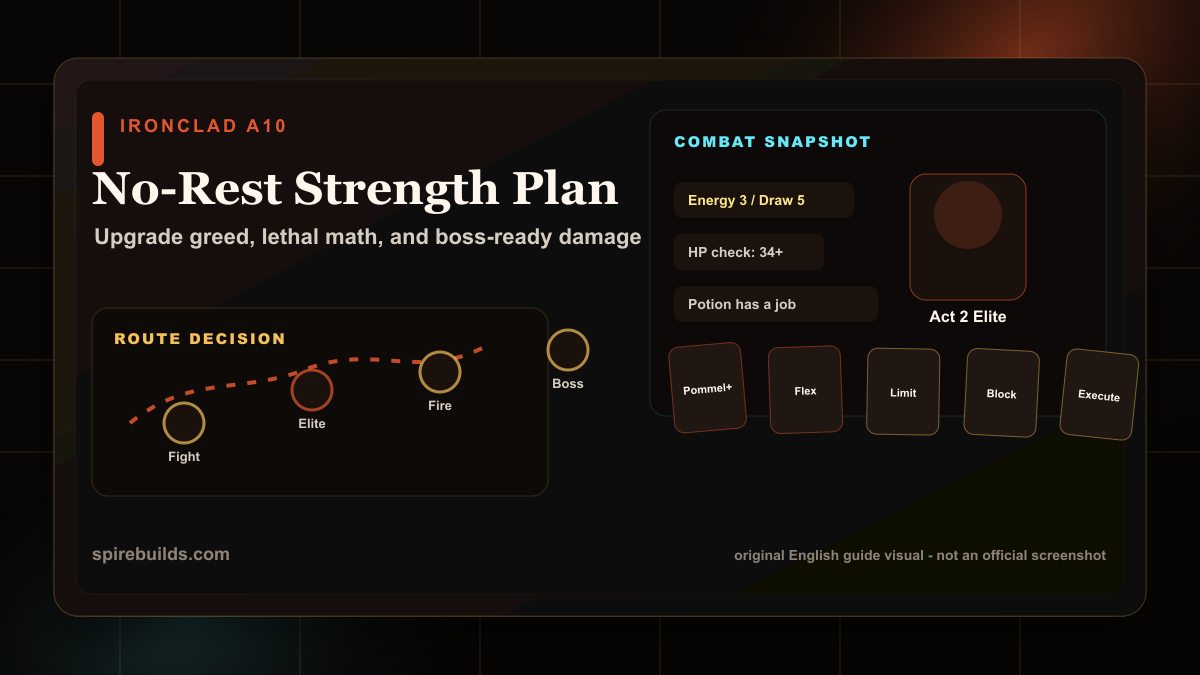
The upgrade-first checklist
Before choosing Upgrade over Rest, check these four things in order:
| Question | Safe Answer | Danger Sign |
|---|---|---|
| Can I kill the next hallway fast? | Two or three strong damage turns | Starter attacks still do most of the work |
| Can I block a bad draw? | One reliable block card or mitigation tool | Defense depends on drawing everything in order |
| Is my potion doing something real? | It covers an elite, boss, or lethal turn | It is just being saved because saving feels good |
| Does the upgrade change a fight? | It hits a damage, block, draw, or cost breakpoint | It is a luxury scaling upgrade |
If two danger signs appear, resting is not cowardice. It is preserving a winning run.
Act 1: damage before identity
The biggest A10 Ironclad mistake is drafting as if the final build already exists. Strength scaling is great, but Act 1 asks a simpler question: can you remove enemies before they remove you? A strong early attack, an upgraded multi-hit card, or any card that improves two-turn lethal is often better than a slow scaling piece.
The ideal Act 1 route has three fights before the first elite, a campfire before or after that elite, and at least one escape branch. Take the elite when your deck has a clear kill plan or a potion that covers the worst case. Skip the elite when your first rewards are defensive filler and your damage is still starter-deck quality.
When strength becomes the plan
Strength becomes the plan after your deck has enough attacks to convert it. A single strength card with weak attacks is not a build. A single strength card with multi-hit attacks, draw, and consistent energy is a win condition.
Look for these signals:
- You already have two attacks that scale well with strength.
- You can draw your scaling before turn 4.
- Your block package buys time without spending every card slot.
- Your boss matchup needs scaling rather than pure front-load.
Once those are true, upgrades should improve the engine. Upgrade strength if it reaches the damage breakpoint faster. Upgrade draw if your best cards are not appearing. Upgrade block if the next elite punishes setup turns.
No-rest math: count health as turns
Do not think of health as a number. Think of it as turns. If the next elite can realistically hit you for 28 before your deck stabilizes, entering at 31 HP is not "safe." It is one bad draw away from disaster.
A simple rule: before a no-rest campfire, estimate the damage you take in the worst normal version of the next fight. Then add 8-12 HP for bad draw tax. If your current health still clears that number, upgrade. If not, rest or path away.
Practical campfire priorities
- Upgrade the attack that changes Act 1 lethal.
- Upgrade the card that makes your scaling arrive earlier.
- Upgrade block only if the next fight threatens burst damage.
- Upgrade draw or energy smoothing once your deck has a clear win condition.
- Rest when the next node can kill you through normal play.
Common mistakes
The first mistake is upgrading strength too early. If you cannot draw enough attacks, the upgrade is mostly decorative. The second mistake is saving potions through the exact fight they were supposed to solve. The third mistake is taking an elite because "Ironclad is strong" instead of because this specific deck is strong right now.
For related reading, use the Ironclad guide, strength build guide, and boss preparation checklist.
FAQ
Is no-rest Ironclad better for SEO-visible challenge runs?
It is more dramatic, but the correct strategy is not always no-rest. Strong guides should explain the decision, not just celebrate the greed.
How much HP should I keep before Act 2?
Most A10 runs want enough health to survive one ugly hallway plus one elite or boss setup turn. The exact number depends on relics, deck speed, and potions.
Should I force strength every Ironclad run?
No. Force damage and consistency first. Strength is excellent when the deck can convert it, but a clean attack/block deck can carry the early game better than a half-built scaling engine.