
Field note: Necrobinder/Osty runs are easiest to understand as tempo-control puzzles. This original guide turns that discussion pattern into a practical A10 checklist. Research starting points include Bilibili Necrobinder searches and the official Slay the Spire 2 Steam news hub.
Necrobinder wins by controlling time
Necrobinder can look like a slow character, but the better description is a time-control character. You spend early turns creating board pressure, then convert marks, doom, summons, or threshold effects into a fight-ending turn. When it works, enemies feel trapped. When it fails, you spend three turns preparing and then die.
The key question is: what is my stabilizing turn? If the deck stabilizes on turn 2, you can take more setup. If it stabilizes on turn 5, A10 will punish the run before the engine matters.
Osty is tempo, not decoration
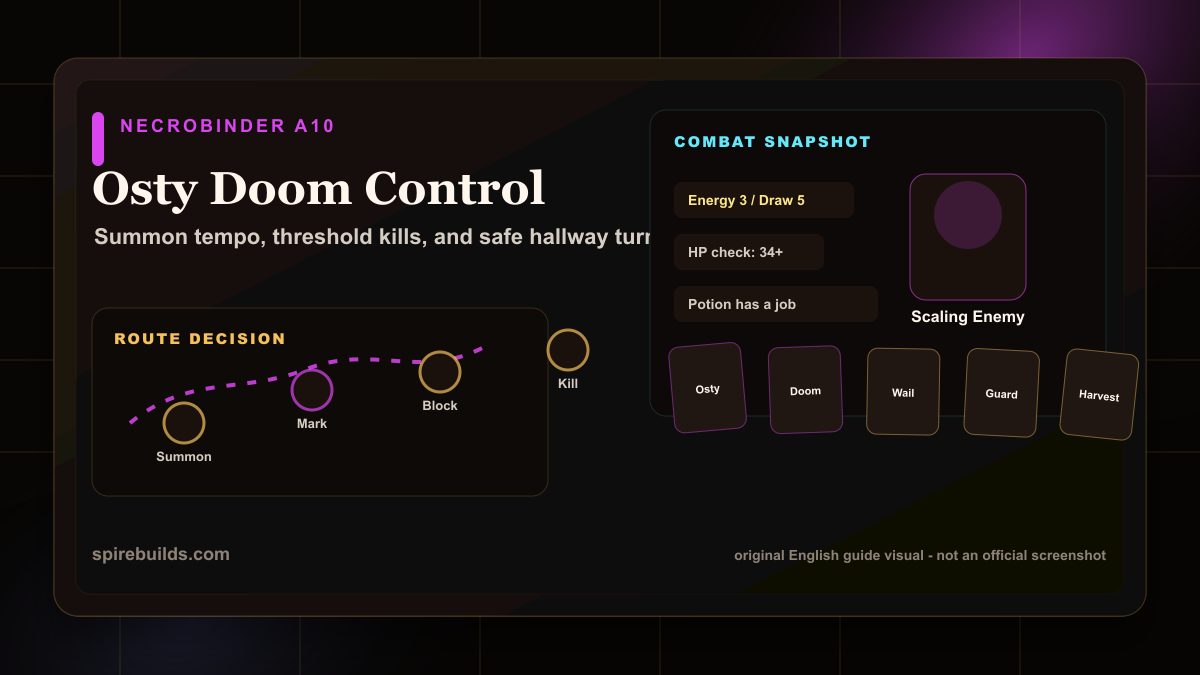
Osty-style summon plans should affect the fight immediately. A summon that only looks good later is not enough. You want the summon to absorb pressure, create damage, improve doom timing, or make future hands easier to play.
| Osty Turn | Good Sign | Bad Sign |
|---|---|---|
| Turn 1 summon | It reduces incoming pressure or sets a kill | You take full damage anyway |
| Turn 2 follow-up | The deck blocks while building doom | You must choose between setup and survival |
| Turn 3 payoff | Enemy is near threshold | The fight is still untouched |
If Osty is not changing the enemy clock, you need more tempo.
Doom thresholds need a delivery system
Doom is not just a number. It is a promise that a future turn will matter. To keep that promise, the deck needs application, draw, and survival. Adding more doom payoff does not help if you cannot apply doom early enough.
Draft doom like this:
- Add one reliable application tool.
- Add block or mitigation so the setup turn is safe.
- Add draw/filtering to find the payoff.
- Add more payoff only after the first package works.
This order keeps the deck from becoming a museum of strong cards that never line up.
Hallway safety
Necrobinder players often over-prepare for bosses and under-prepare for hallway fights. A hallway enemy does not care that your Act 3 plan is beautiful. It attacks now.
Good hallway tools are immediate. They block, kill small enemies, or apply pressure without needing four-card sequencing. A10 decks should contain a few cards that are boring but dependable. Those cards are what let your fancy doom engine reach the boss.
When to stop adding slow cards
Stop adding slow payoff when your deck already has a win condition but lacks consistency. At that point, remove weak cards, buy draw, upgrade defense, or take routes that let the current engine mature.
| Deck Problem | Better Fix Than More Payoff |
|---|---|
| Cannot survive turn 2 | Block, mitigation, safer route |
| Cannot find doom cards | Draw or card removal |
| Boss takes too long | One scaling upgrade, not three new slow cards |
| Hallways hurt too much | Front-load damage or potion use |
Boss plan
Against long bosses, Necrobinder wants to arrive with a clean engine and enough health to absorb one ugly turn. Do not save every potion for the final boss if using one earlier keeps your run alive and lets you upgrade later.
Your boss checklist:
- Can I apply doom before the boss outscales me?
- Can I block while setting up?
- Do I have a backup plan if the summon appears late?
- Does my final campfire upgrade change the matchup?
If the answer is no, fix that before adding more win-more cards.
For more Necrobinder basics, read the Necrobinder guide, summon build guide, and status effects guide.
FAQ
Is Osty required?
No, but Osty-style tempo is valuable because Necrobinder needs early fight control. Any card package that creates safe setup turns can fill a similar role.
How many doom cards should I draft?
Enough to apply doom reliably and convert it. After that, consistency matters more than another payoff card.
What is the biggest Necrobinder A10 mistake?
Treating the deck like a boss simulator. You still need hallway safety, elite timing, and bad-draw defense.