


Field note: Regent discussion often works best as a one-board timing problem: setup, forge, hold, burst. This guide turns that pattern into an original English guide. Research context: Bilibili Regent searches and official Slay the Spire 2 news.
Regent is a timing character
Regent runs often look confusing from the outside because the best turn is not always the current turn. Some decks want to set up stars, wait for a forge breakpoint, then release a huge Sovereign Blade turn. That makes the character exciting, but it also creates the easiest A10 mistake: waiting one turn too long.
Regent is not about greed. Regent is about controlled delay. You delay only when the next turn is safer or much stronger. If the enemy is about to punish you, you spend resources now.
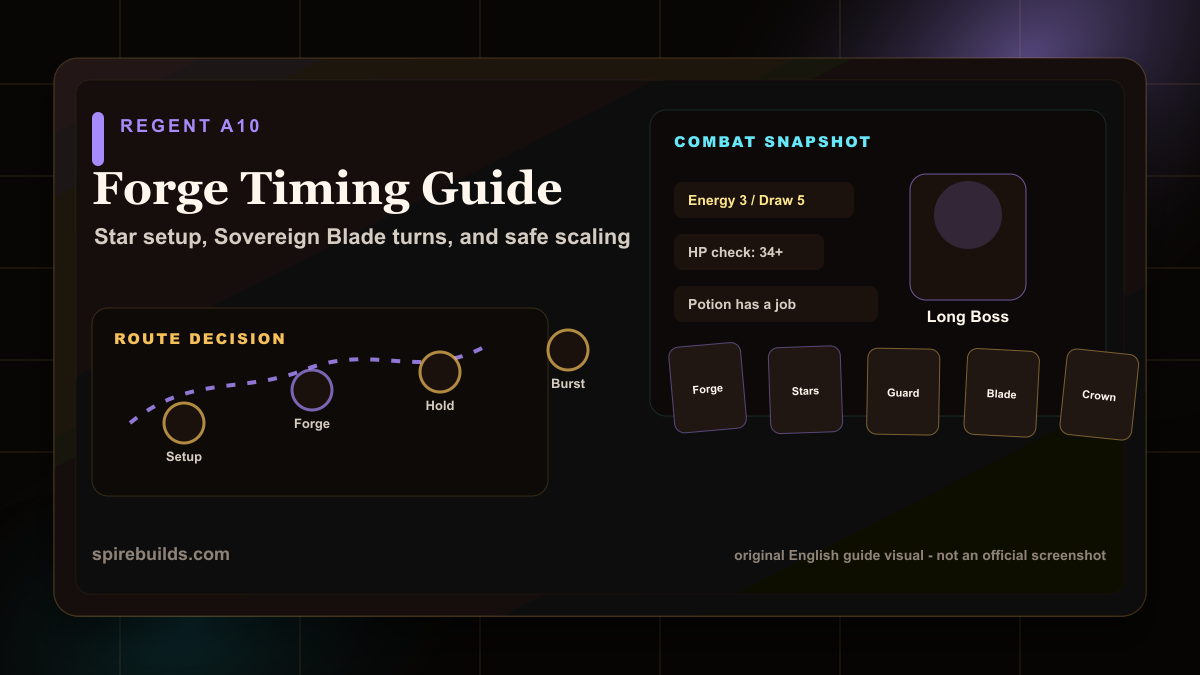
The forge timing rule
The simple rule is:
Hold the payoff if you can block the next attack; spend the payoff if blocking requires the same cards you are trying to save.
That rule prevents most Regent deaths. Players lose when they protect a beautiful future turn while taking 30 damage in the present. A good Regent deck still respects enemy patterns.
| Situation | Best Default | Reason |
|---|---|---|
| Enemy not attacking | Setup stars or forge | Free setup is the character's biggest advantage |
| Enemy attacking lightly | Block and keep the engine | You can delay without losing health |
| Enemy attacking hard | Spend burst or potion | Surviving is worth more than perfect sequencing |
| Boss phase shift coming | Hold only with block | Burst timing matters, but lethal risk matters more |
Building the Regent deck
Regent wants three layers. First, reliable early cards that keep the deck alive. Second, setup cards that turn future hands into better hands. Third, a payoff card or line that converts preparation into lethal damage.
Do not draft only the third layer. A deck full of payoff cards has nothing to pay off. Early in the run, take cards that stabilize your first three turns. Once the deck is safe, add forge and star tools that make your strong turns stronger.
Sovereign Blade turns
Sovereign Blade-style turns should be treated like boss resources. You do not need to spend them the moment they appear. Ask three questions:
- Does using it now remove a dangerous enemy?
- Does waiting create lethal next turn?
- Can I survive the enemy's next pattern without using it?
If the answer to the first question is yes, spend it. If the answer to the second and third is yes, hold. If you are unsure, spend earlier on A10. Health is harder to recover than style points.
Defense before elegance
Regent decks often die with strong scaling because they never bought enough time. You need defense that works while setup is happening. That can mean block, mitigation, weakness, potion coverage, or route choices that avoid an elite before the engine is ready.
The clearest sign your Regent run is improving: you can explain how the deck survives turn 2 and turn 3. If your only answer is "I hope I draw the right card," the deck still needs work.
Route planning
Choose early fights when you need card rewards. Choose events when your deck already has direction or needs relief. Take elites when you have a potion, a strong upgrade, or enough damage to end the fight before setup becomes a liability.
Regent loves campfire upgrades that change timing. A cost reduction, better block number, or stronger setup card can be more valuable than raw damage if it lets you create a safe forge window.
Common mistakes
The first mistake is holding burst through a lethal pattern. The second is taking every setup card and forgetting that enemies attack. The third is treating Regent as a combo-only character. The best runs are not all combo. They are attack, block, setup, and payoff in the right order.
For more context, read the Regent guide, boss preparation checklist, and best map pathing strategy.
FAQ
Should Regent upgrade defense first?
Sometimes. If defense is what creates safe setup windows, a defensive upgrade is effectively a damage upgrade later.
Is it bad to spend payoff cards early?
No. Spending early is correct when it prevents damage, kills a scaling enemy, or protects a potion for a harder fight.
What makes a Regent deck consistent?
Enough early tempo, a clear setup package, one payoff direction, and route choices that do not demand perfect draws.